
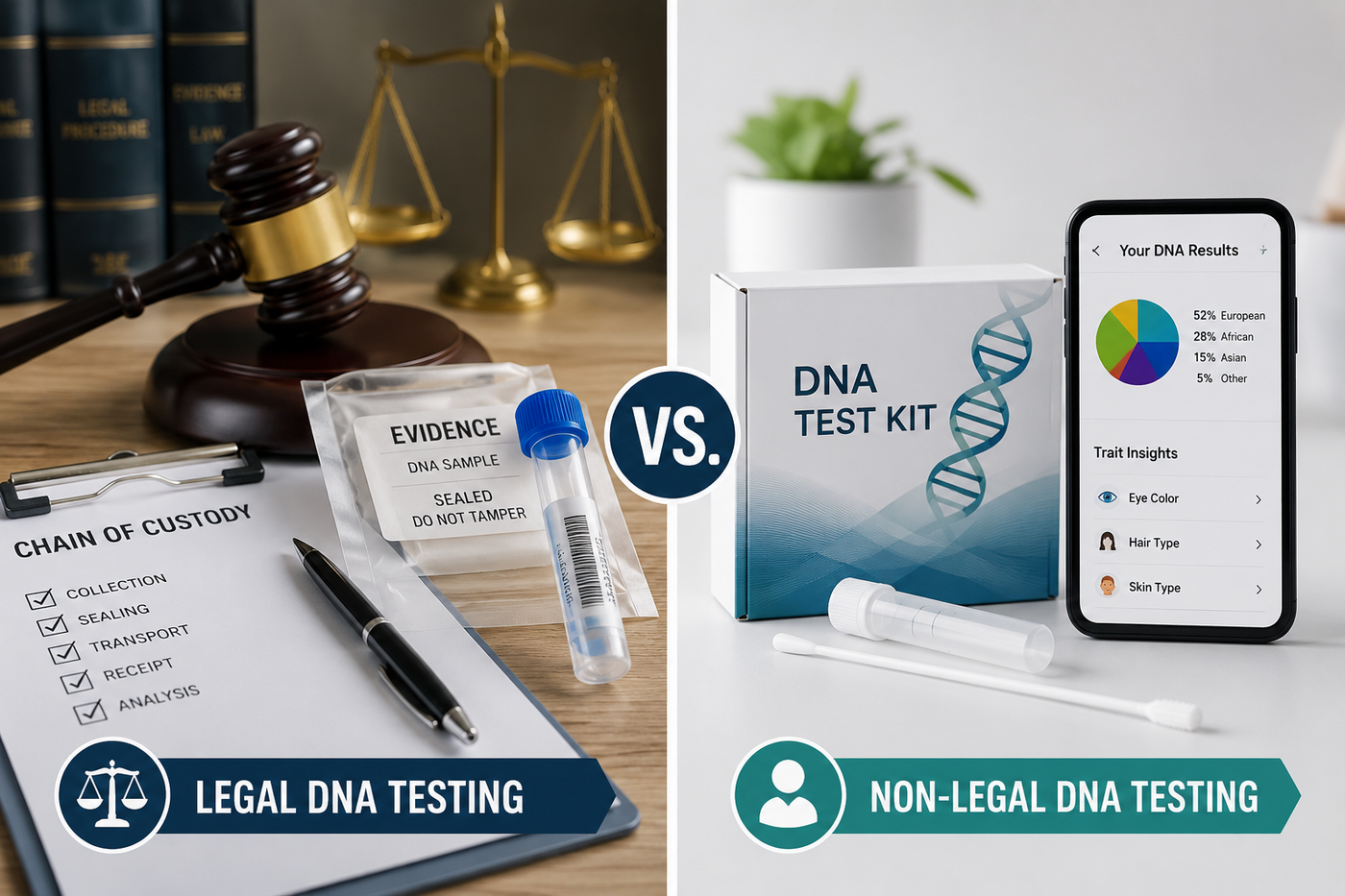
If you've ever searched for a paternity test online, you've probably noticed something confusing: two tests that look almost identical can have wildly different prices, processes, and purposes. One ships to your door in a plain box. The other requires an appointment, a witness, and a photo ID. They use the same science. So why are they treated so differently?
The answer comes down to a single phrase you'll see over and over: chain of custody. And understanding it is the difference between getting an answer you can simply know and getting an answer a court, a government agency, or an attorney will actually accept.
Here in Nashville and across Middle Tennessee, we talk to people every week who ordered the wrong type of test. They got accurate results, paid good money, waited anxiously for the answer — and then found out those results couldn't be used for the one thing they needed them for. This post is meant to make sure that never happens to you.
What "Legal" Actually Means
When people hear "legal DNA test," they sometimes assume it means the science is somehow better or more accurate. It isn't. The laboratory analysis behind a personal test and a legal test is the same. A modern paternity test that returns a 99%+ probability of paternity is just as scientifically reliable whether you bought it at a pharmacy or scheduled it through an accredited provider.
The difference isn't the science. It's the documentation — specifically, proof of who was tested, who collected the samples, and that no one tampered with anything along the way.
A "legal" test is one where every step is documented and verified by a neutral third party so the results can stand up to scrutiny. That verified process is what makes the result admissible in court and acceptable to agencies that establish paternity, child support, custody, or benefits.
Chain of Custody, Explained Simply
Chain of custody is the paper trail that proves the sample tested actually came from the person whose name is on the result.
In a non-legal, at-home test, you collect the cheek swabs yourself. There's no one to confirm that the swab labeled "father" actually came from the father, or that the swab labeled "child" came from the child. For your own peace of mind, that's usually fine — you know who you swabbed. But a court has no way to verify any of it.
In a legal test, the process is controlled from start to finish:
-
A neutral, trained collector — not a family member — handles the samples.
-
Every person tested presents government-issued photo identification, and that ID is recorded.
-
The collector witnesses the swab being taken, then seals and labels each sample on the spot.
-
The samples travel to an accredited laboratory in tamper-evident packaging, with documentation at every handoff.
That unbroken, documented trail is the chain of custody. It's what lets a judge, a caseworker, or an attorney trust that the result is genuinely connected to the people it names.
Court Use vs. Personal Knowledge
A helpful way to decide which test you need is to ask yourself one question: What am I going to do with the answer?
If the answer is "I just need to know for myself" — for your own certainty, to settle a private question, or to have a conversation with family — a non-legal test gives you the same accurate genetic answer at a lower cost and with more convenience.
If the answer involves anyone else acting on the result — a court, the state, an attorney, an employer's benefits administrator, an immigration office — you almost certainly need a legal test. Personal-knowledge testing, no matter how accurate, generally cannot be entered as evidence or accepted by government agencies, because there's no verified chain of custody behind it.
In Tennessee, this distinction matters a great deal. Courts here can and do order genetic testing in contested paternity cases, and a temporary order of child support can be set when there's clear and convincing evidence of parentage based on those tests. An at-home kit simply doesn't carry that weight in a courtroom.
Why People Accidentally Order the Wrong Thing Online
The retail DNA market is built for convenience, not for nuance. A box on a shelf or a one-click online order rarely explains chain of custody, and the words "legal" and "non-legal" are easy to gloss over when you're stressed and just want an answer.
The most common scenarios we see:
-
Someone buys an at-home kit, then learns they need results for a custody case. Now they have to start over with a legal test, having lost both time and money.
-
A parent assumes "DNA is DNA" and doesn't realize the courtroom cares about how the sample was collected, not just what it shows.
-
An attorney requests "a paternity test," and the client doesn't know to specify a court-admissible one.
None of these mistakes are the result of carelessness. The system just isn't designed to make the difference obvious. That's exactly why we walk every client through it before anything is ordered.
Situations That Require Legal Testing
You'll generally need a legal, court-admissible DNA test if your situation involves:
-
Establishing or contesting paternity in court
-
Child support orders or modifications
-
Custody and visitation disputes
-
Adding or correcting a father's name on a birth certificate through official channels
-
Inheritance or estate matters
-
Social Security, veterans', or insurance benefits tied to a parent-child relationship
-
Immigration cases requiring proof of biological relationship
When in doubt, lean toward legal testing. The marginal extra cost is far smaller than the cost of redoing the test later — and you can't always go back and re-create a chain of custody after the fact.
If you're unsure which option fits your situation, you can learn more about how our process works on our services page, or simply reach out and ask — we'll help you figure it out before you spend a dollar.
Common Questions We Hear
Is a legal DNA test more accurate than an at-home one? No. The laboratory science is the same. The difference is the documented chain of custody that makes legal results admissible in court and acceptable to agencies. Accuracy isn't the variable — verifiability is.
Can I use my at-home test results in court later if I need to? Generally, no. Without a verified chain of custody, results from a self-collected kit usually can't be entered as evidence or accepted by government agencies, even if they're accurate.
How do I know which test I need? Ask yourself what you'll do with the answer. If it's purely for your own knowledge, a non-legal test works. If anyone else — a court, the state, an attorney — needs to rely on it, you need a legal test. When unsure, we're happy to talk it through with you first.
A Final Word
Clarity shouldn't come with an asterisk. The whole point of a paternity test is to give you a definitive answer — and the last thing you want is to discover that your answer doesn't count where it matters most. Knowing the difference between legal and non-legal testing up front protects your time, your money, and your peace of mind.
If you have questions about which type of test fits your situation, we're here to help. Call us at 615-813-7334, email info@surepathdna.com, or contact us here. No pressure — just clarity.
For background on how paternity is formally established in Tennessee, including voluntary acknowledgment and court-ordered testing, see the Tennessee Department of Human Services Voluntary Acknowledgment of Paternity program. (Opens in a new tab.)
Related Reading:
-
Fatherhood Isn't Just Emotional — Sometimes It's Legal
-
5 Common Myths About DNA Testing — And What People Get Wrong
-
What Happens After You Get the Answers?