
If you're asking how accurate a DNA paternity test is, I already know you're not asking out of curiosity. You're asking because a lot is riding on that answer. Maybe it's a child's last name, child support, a custody case, or just finally being able to sleep at night.
So let me sit down with you and give it to you straight, the way I would if you called me.
The Short Answer
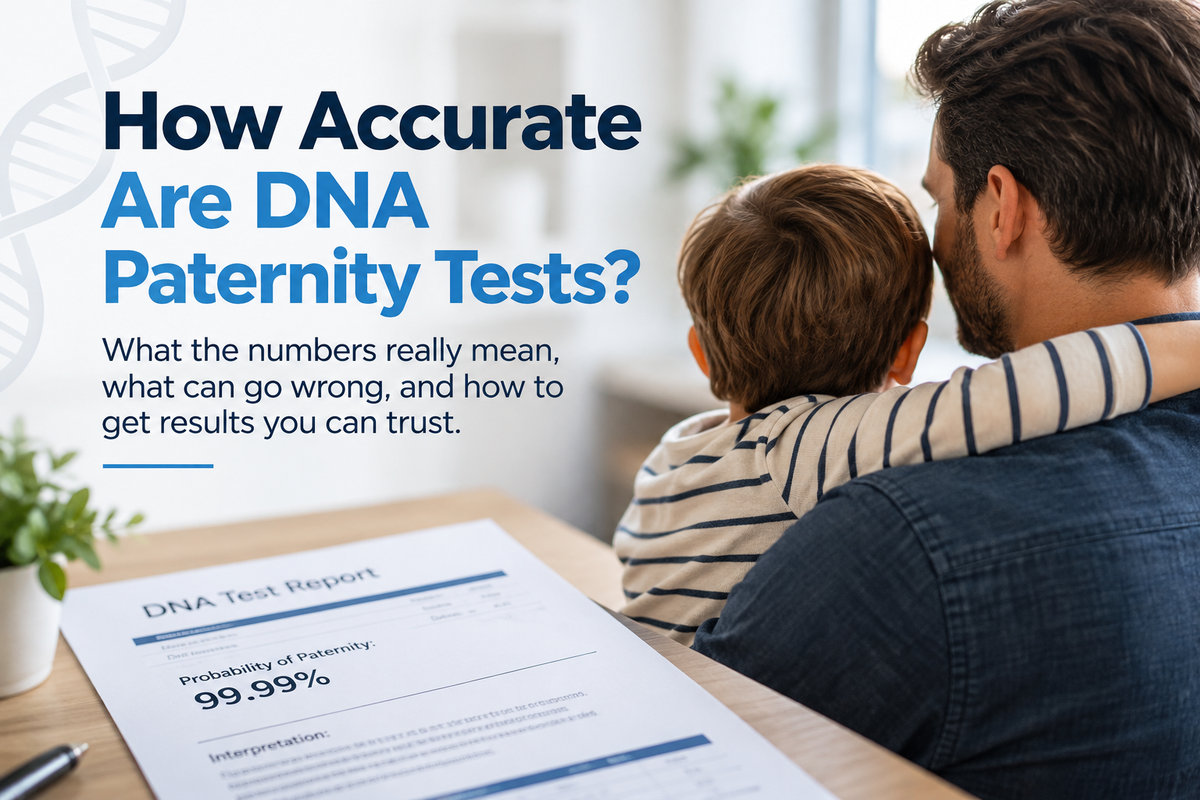
A paternity test done through an accredited laboratory is extremely accurate. When the man tested is the biological father, results are typically reported at 99% or higher, and very often 99.99% or more. When he is not the father, the result comes back as an exclusion with a 0% probability of paternity.
But here's what I want you to understand. The lab science is rarely where things go wrong. In my experience, accuracy is about more than what happens inside the lab. It's about who collected the samples, who handled them, and whether anyone had the chance to tamper with them before they ever reached the lab.
What People Are Really Asking When They Ask About Accuracy
When families reach out to SurePath, "how accurate is it?" is almost never the whole question. Underneath it, I usually hear one of three worries.
"Is there any chance the results could be wrong?"
This is the big one. People want to know if they can trust the answer enough to make life decisions based on it. That's a fair question, and you deserve a real answer instead of a sales pitch.
The testing itself compares specific locations in the child's DNA to the alleged father's DNA. A child gets half of their DNA from each biological parent, so the lab is looking at whether the father's half lines up. When it's done by an accredited lab with properly collected samples, the science is solid. The risk comes from the human side of the process, which I'll get into below.
"Does the mother need to be tested for it to be accurate?"
I get this question all the time. When I tell people the mother isn't required for a paternity test, they get nervous. They assume leaving her out makes the result less reliable.
Here's the truth. A paternity test is between the alleged father and the child. A two-party test with just those two people still gives you an accurate, reliable result. Including the mother can add extra strength to the analysis, because it helps the lab see which half of the child's DNA came from her. That's why we offer it as an option. But not having her there does not make your test inaccurate, and it shouldn't stop you from getting answers.
"How do I know the results actually belong to us?"
This is the question that doesn't get talked about enough. People want to know their samples were handled correctly and that the result on that report truly belongs to the people who were tested.
This is exactly why SurePath works as a neutral third party. Nobody other than the collector touches the samples. Not the mother, not the father, not a grandmother trying to help. That one rule protects everybody involved.
Where Paternity Tests Actually Go Wrong
If I had to point to the biggest reason a paternity result can't be trusted, it wouldn't be the lab. It would be the collection.
The At-Home Kit Problem
At-home kits are easy to find and easy to buy. And I understand why people grab them. But think about what happens with an at-home kit:
-
There's no neutral third party watching who gets swabbed
-
Nobody is checking IDs to confirm each person is who they say they are
-
Someone involved in the situation is the one packing up the samples
-
Someone involved in the situation is the one mailing them to the lab
If everyone involved trusts each other completely, maybe that's fine for peace of mind. But paternity questions usually come up when trust is already shaky. When you're dealing with someone who may not be trustworthy, an at-home kit leaves the door wide open for samples to be swapped, mixed up, or manipulated. The lab can only test what it receives. If the wrong cheek got swabbed, the lab will give you a very accurate answer about the wrong person.
Getting the Wrong Type of Test
The other thing I see is people getting a test that doesn't fit what they'll need it for later. An at-home or personal test is for peace of mind only. Courts generally will not accept it, because there's no documented chain of custody showing who was tested and how the samples were handled.
So someone gets their answer, then months later realizes they need it for child support, custody, or a birth certificate change. Now they're paying to test all over again. That's time, money, and stress nobody needed.
Understanding Your Results Without the Jargon
I'm not a lab scientist, and I'm not going to pretend to be one. But I've walked enough people through their results to know where the confusion comes from. Most of it comes down to one number.
Why You Won't See 100%
A lot of people get hung up on the fact that their report doesn't say 100%. I understand. When it's your family, you want certainty.
Here's how I explain it. The probability of paternity is a calculation. It measures how strongly the genetic evidence supports a biological relationship between the man and the child. Because it's a statistical calculation, laboratories report a very high percentage, like 99.99%, rather than an absolute 100%.
That does not mean the lab is guessing. It does not mean your results are unreliable. It's simply how the math is reported. A result of 99.99% means the DNA evidence overwhelmingly supports that he is the biological father.
What a 0% Result Means
On the other side, you may see the alleged father listed as "excluded" with a 0% probability of paternity. That means the DNA evidence does not support him being the biological father of the child.
There's a lot more to say about how these numbers are calculated, and I'll break that down in its own post. For now, just know this: a high percentage is a strong yes, and an exclusion is a clear no.
Why the Process Matters as Much as the Lab
Accuracy isn't only a number on a report. It's also whether you trust how you got there. I learned that firsthand.
What My Own Court-Ordered Test Taught Me
Before I ever started SurePath, I went through court-ordered DNA testing myself. The whole experience felt cold. And once the swabbing was done, that was it. Nobody told me the samples were heading to the lab. Nobody said, "You should have results in this many days." There were no next steps and no follow-up. It was just, "Okay, thank you."
When you're already anxious, silence feeds doubt. You start wondering where your samples went, who handled them, and when you'll hear something. That experience is a big part of why SurePath exists. I wanted people to walk away knowing exactly what happens next.
What 13 Years in Clinical Research Taught Me
My background is in clinical research. I've spent more than 13 years in an industry where documentation, sample handling, and following protocol are everything. That work trained me to pay attention to details, to ask questions, and to never assume a step can be skipped just because it seems minor.
Here's how that shows up in a legal paternity test:
-
Checking proper identification for every person being tested
-
Labeling every sample correctly
-
Documenting the collection
-
Maintaining the chain of custody from collection to the lab
In a legal test, the chain of custody is critical. It's the paper trail that proves the samples came from the right people and weren't tampered with along the way. Skip a step, and you've put the whole result at risk.
Clinical research also taught me how to communicate. As a project manager, I explain complex processes to people at every level and make sure nobody is left guessing. I bring that same approach to every family I work with.
What Accurate Testing Looks Like at SurePath
Everything we do is built around protecting the accuracy of your result and your peace of mind along the way.
-
We talk first. You can't just click a button and book. I want to understand your situation so you get the right test the first time.
-
We're a neutral third party. We don't take sides, and we don't let anyone other than the collector handle the samples.
-
We meet at a neutral location. Collections happen at a safe, neutral location we arrange, not in anyone's home.
-
We verify identity. For legal tests, every person shows proper identification before collection.
-
We document everything. Samples are labeled, the collection is documented, and the chain of custody is maintained all the way to our accredited laboratory partner.
-
We tell you what happens next. You'll know where your samples are going and what to expect before we part ways. Nobody leaves with just a "thank you."
My One Piece of Advice Before You Test
If you remember nothing else from this post, remember this: know what you're going to need the test for before you get tested.
This is the reason I like to talk with people before they can schedule. At the time you call me, you may not think you'll ever need this for court. But if there's any chance you'll need it later for custody, child support, or a birth certificate, go ahead and get the legal paternity test now.
A legal test gives you the same accurate answer as a peace-of-mind test, plus the documentation a court needs. Paying once is a whole lot better than paying twice.
Frequently Asked Questions
Can a paternity test be wrong?
When the samples are collected correctly and tested by an accredited lab, paternity results are extremely reliable. Most problems come from the collection side, like at-home kits where samples can be swapped or mislabeled before they ever reach the lab.
Is a test without the mother still accurate?
Yes. A test with just the alleged father and the child is accurate and reliable. Adding the mother can strengthen the analysis, but she is not required.
Is an at-home test as accurate as a legal test?
The lab science can be the same. The difference is control over the samples. A legal test uses a neutral collector, ID verification, and a documented chain of custody, which is why courts accept it and at-home results generally aren't.
Why doesn't my result say 100%?
Because the probability of paternity is a statistical calculation. A result like 99.99% is how labs report a very strong match. It's not a sign of doubt.
Get Answers You Can Trust
You deserve a result you can believe in and a process that doesn't leave you in the dark. If you're in the Nashville or Middle Tennessee area and you have questions about paternity testing, let's talk first. Start with our confidential DNA intake or call us at 615.813.7334, and we'll help you figure out the right test for your situation.
From uncertainty to answers. That's what we're here for.